The Unsung Hero of the Free-Weight Area
Dumbbell racks rarely get the attention they deserve when gym owners plan their equipment purchases. The focus tends to fall on the dumbbells themselves — weight ranges, materials, coatings — while the racks are treated as an afterthought. This is a mistake. A well-chosen dumbbell rack system transforms a chaotic free-weight area into an organised, efficient, and professional space that members appreciate and staff can maintain.
Types of Dumbbell Racks
The three main rack configurations are horizontal racks, vertical racks, and A-frame racks. Horizontal racks feature flat or slightly angled shelves arranged in tiers — typically two or three levels. They provide excellent visibility and easy access, making them the most popular choice for commercial gyms. Vertical racks store dumbbells upright and use less floor space but can be harder to load and unload, especially with heavier weights.
A-frame racks taper from a wide base to a narrow top, creating a pyramid shape. They offer good stability and can be placed in the centre of a room for 360-degree access. Some facilities use a combination of rack types to accommodate different weight ranges — horizontal racks for heavier dumbbells and A-frame racks for lighter weights used in group fitness areas.
Capacity Planning
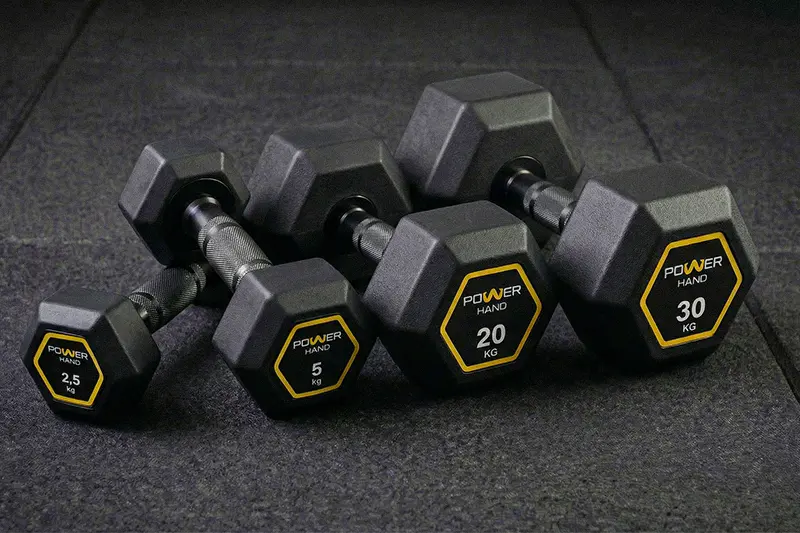
Before selecting a rack, map out your complete dumbbell inventory. A commercial gym typically stocks hex dumbbells from 2.5 kg to 50 kg in 2.5 kg increments — that is 20 different weights, requiring 20 pairs and rack space for 40 individual dumbbells. Growing gyms should plan rack capacity for at least 20 % more than their current inventory to accommodate future expansion.
Each shelf or tier has a weight limit that must not be exceeded. Heavy dumbbells — 30 kg and above — should be placed on the lowest tier for safety and stability. Lighter weights go on upper tiers where they are easier to reach without bending.
Material and Construction
Commercial dumbbell racks must be built from heavy-gauge steel tubing with welded joints — not bolted or press-fit connections that can loosen over time. The frame should feel completely rigid when loaded; any flex or wobble indicates insufficient structural strength. Powder-coated finishes protect against scratches and corrosion, maintaining a professional appearance over years of use.
Shelf surfaces should have rubber or polyurethane liners to protect both the rack and the dumbbells from impact damage. These liners also reduce noise when members place dumbbells back on the rack — a small detail that contributes significantly to the overall gym atmosphere.
Spacing and Ergonomics
The spacing between dumbbell positions on a rack matters more than most people realise. Each pair needs enough lateral space that members can grip and remove a dumbbell without bumping the adjacent pair. For hex dumbbells, a minimum of 200 mm between centres accommodates weights up to 50 kg comfortably.
Vertical spacing between tiers should allow members to access lower shelves without awkward bending or upper shelves without reaching above shoulder height. An ergonomic rack design places the most frequently used weights — typically 8 kg to 20 kg — at a comfortable waist-to-chest height.
Weight Labelling and Organisation
Clear weight labels on the rack itself — not just on the dumbbells — dramatically improve re-racking compliance. When members can see exactly where each weight belongs, they are far more likely to return dumbbells to the correct position. Colour-coded labels, numbered positions, and weight markings on the rack frame all contribute to a well-organised area.
Some premium racks include angled shelves that tilt the dumbbells slightly toward the user, making weight markings easier to read at a glance. This small design feature reduces the time members spend searching for the right weight and keeps the area flowing smoothly during peak hours.
Floor Space Considerations
A standard three-tier horizontal rack holding 20 pairs of dumbbells requires approximately 3 metres of wall space and 0.8 metres of depth. Add two metres of clearance in front for exercise space, and the total footprint is roughly 3 metres by 2.8 metres. For gyms with limited space, two-sided island racks placed in the centre of the room can serve twice the capacity in the same linear space.
Matching Racks to Your Dumbbells
Not all racks fit all dumbbell styles. Round dumbbells require saddle-style cradles to prevent rolling, while hex dumbbells sit flat on any shelf. When ordering from a single manufacturer like Anka Force Sport, you can ensure perfect compatibility between your dumbbells and racks — shelf dimensions, weight capacities, and spacing are all designed to work together.
Conclusion
The right dumbbell rack is an investment in organisation, safety, and member experience. Choose racks that match your dumbbell range, accommodate future growth, and integrate seamlessly into your gym layout. A well-organised free-weight area with clearly labelled, properly sized racks signals professionalism and attention to detail — qualities that retain members and attract new ones. Contact Anka Force Sport for rack options designed to complement our full range of commercial-grade hex dumbbells.