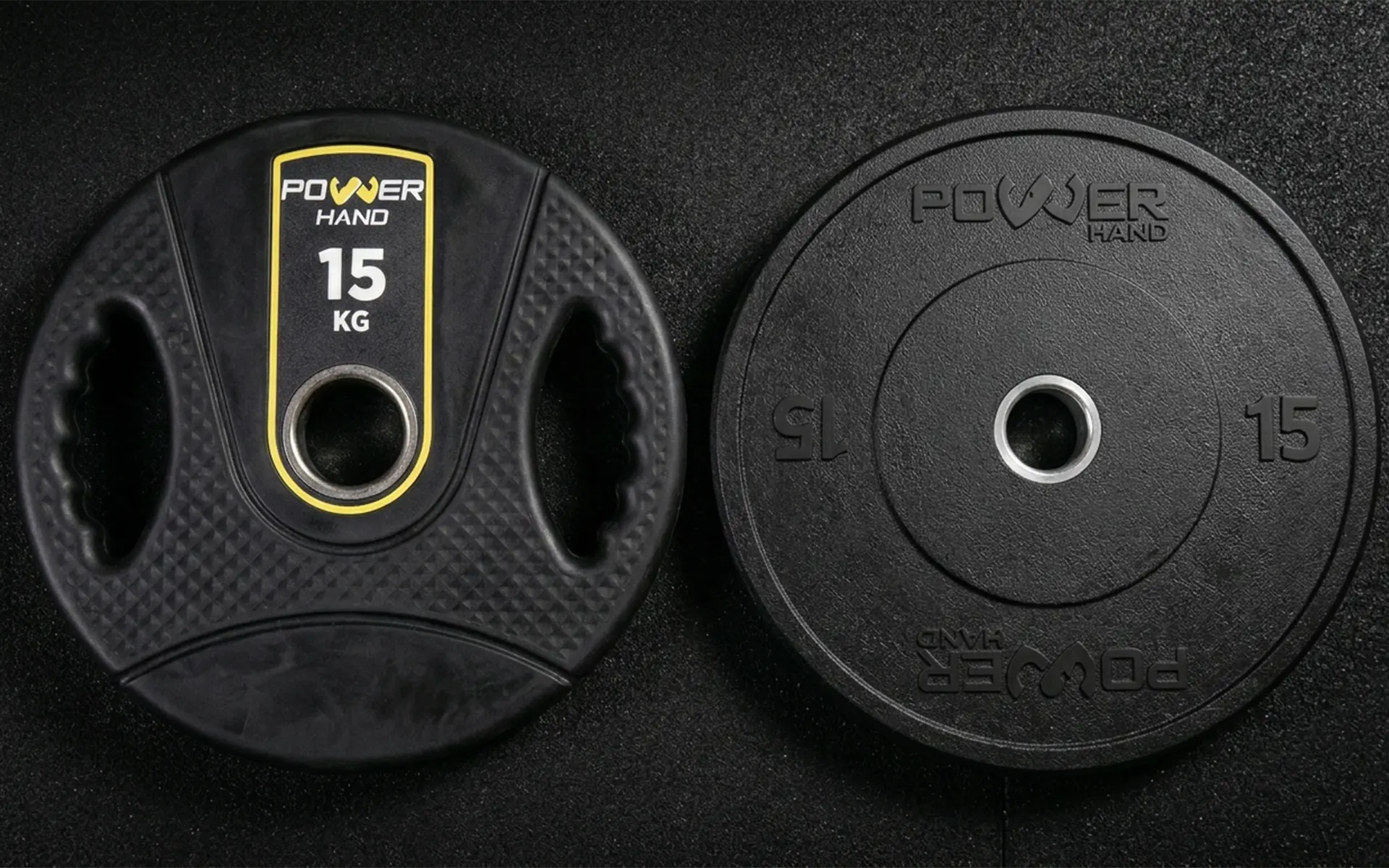
If you're equipping a gym and trying to decide between bumper plates and traditional Olympic (cast iron) plates, the answer depends on what's going to happen on the gym floor. Both fit a 50 mm Olympic bar sleeve. Both are used by serious lifters. But they're optimized for completely different scenarios — mixing them up means either over-paying for capability you don't need, or under-protecting equipment you do need to drop.
The short answer
- Bumper plates — recycled rubber construction, designed to be dropped from overhead. Olympic weightlifting, CrossFit, anywhere a barbell hits the floor with weight on it.
- Olympic plates (cast iron) — metal construction, not designed for repeated drops. General strength training, powerlifting (where the bar is set down rather than dropped), commercial-gym free-weight floors with bumper-plate alternates available.
If your gym does any meaningful Olympic-lifting or CrossFit work, you need bumper plates. If your gym is general strength training and the bar gets racked rather than dropped, Olympic plates are fine and cheaper.
What's actually different
| Property | Bumper plate | Olympic (cast iron) plate |
|---|---|---|
| Material | Recycled rubber + steel hub | Cast iron |
| Diameter at 20 kg | ~450 mm (standard) | ~450 mm (varies by maker) |
| Thickness at 20 kg | ~70 mm | ~30 mm |
| Floor noise on drop | Low / dampened | Loud / metal-on-metal |
| Floor damage risk | Minimal (rubber absorbs) | High (cracks tile, dents wood) |
| Bar damage on drop | Minimal | Significant (sleeves take impact) |
| Cost per kg | Higher | Lower |
| Bar wobble at heavy weight | More (thicker plates push out) | Less |
Diameter is the critical detail
All bumper plates from 5 kg up are typically the same outer diameter — ~450 mm. The reason: when you drop a barbell from overhead with bumpers, the plates need to land on the ground at the same time, distributing impact across all of them. If plates were different diameters, the smaller ones would rotate downward and the bar would slam into the floor unevenly.
Olympic cast-iron plates don't share this constraint. Plate diameter scales with weight: a 25 kg cast iron is much larger than a 5 kg cast iron. This is fine for benched-down strength training but won't work for Olympic lifting from above the head.
When bumper plates are required
- Olympic weightlifting (snatch, clean & jerk): the lift fails by dropping the bar. Without bumpers, the bar slams the floor and breaks something each time.
- CrossFit: high-rep barbell movements often end with controlled drops. Bumpers protect the floor and the bar.
- Functional fitness studios: any program with thrusters, push-press, or floor-to-overhead movements at meaningful weight.
- Hotel gyms with no soundproofing budget: bumpers reduce drop noise meaningfully — metal plates aren't acceptable above bedrooms.
When Olympic cast-iron plates are fine
- Powerlifting (squat, bench, deadlift): the bar is racked or set down between reps; no drops.
- General strength-training floors with separate Olympic-lifting area: if the box also has bumpers for the lifting platforms, cast-iron plates serve the rest of the floor.
- Commercial gyms where members don't drop bars: a typical commercial floor with no Olympic-lifting program rarely needs bumpers.
- Home / residential setups: if the lifter doesn't drop, cast iron is cheaper and takes less storage space (much thinner per kg).
Mixing bumpers and cast-iron
Many serious commercial gyms run a mix:
- Bumper plates 5/10/15/20/25 kg to cover the “working weight” range where lifters might drop the bar
- Cast-iron change plates 1.25 / 2.5 / 5 kg for fine-tuning loads
- Cast-iron heavier plates (25 kg+) for powerlifting platforms where the lift gets set down rather than dropped
For a Dubai or European commercial gym, a typical kit might be: 4 pairs each of bumper plates 10/15/20/25 kg, plus a set of three-grip cast-iron Olympic plates in 1.25/2.5/5 kg pairs for fine increments.
Construction quality matters more than the category
Within bumper plates, the make-or-break detail is the steel hub bonded to the rubber. Cheap bumpers use a hub that loosens or pops out after several months of drops, leaving you with a 20 kg rubber ring with no center connection to the bar. Quality bumpers compress-mold the rubber around a steel insert with a substantial bond surface. Look for:
- Steel insert (hub) flush with the plate face on both sides — not recessed where rubber wear can expose it
- Recycled-rubber compound (not virgin rubber, which is over-spec for this use and more expensive)
- Even color across the plate face (uneven color can indicate inconsistent compound mixing)
- Manufacturer warranty: 12 months minimum on hub-bond integrity
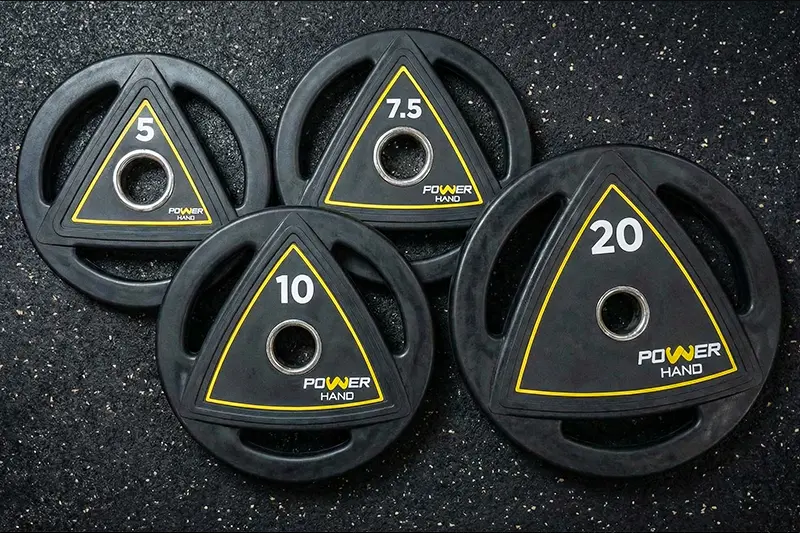
For cast-iron Olympic plates, the make-or-break detail is dimensional tolerance and finish quality. Plates with rough edges or a poorly-finished center hole cause sleeve scratching and uneven loading. Three-grip designs are easier to handle than two-grip or no-grip equivalents.
What we manufacture
We make both:
- Bumper plates — 5/10/15/20/25 kg, recycled-rubber compound, IWF color-coded or all-black, 450 mm diameter for 10 kg+, vulcanized steel hub bond
- Three-grip Olympic plates — cast iron, 1.25/2.5/5/7.5/10/15/20/25 kg, 50 mm center hole, three-grip design for handling
Both fit any 50 mm Olympic bar sleeve, so you can mix on the same bar.
Buying decision in three questions
- Will members or athletes drop the bar from overhead? If yes — bumpers are required for the working-weight range.
- Is the gym above or near sleeping/working spaces? If yes — bumpers, even for non-Olympic-lifting use, because of noise.
- Is the floor concrete with no rubber underlayment? If yes — bumpers protect both the floor and the equipment.
If all three answers are no, cast-iron Olympic plates work fine and let you stretch the budget further per kg.
Bottom line
Bumper plates and Olympic plates aren't competing for the same job — they're solutions to different gym problems. Pick by what's going to happen on the floor, not by what looks more “serious.” A well-equipped commercial gym usually has both: bumpers for the lifting platforms, cast-iron for the bench-and-rack areas.
If you're scoping a project, browse our bumper plate range and Olympic plate range, or get in touch for a project-specific mix. We ship to Europe in 3–7 days and to the UAE in 6–9 days, with no MOQ.